Wednesday, August 6, 2025

🌾 August 2025: A Season of Reckoning and Renewal

August always feels like a hinge—summer wanes, school years begin, and the air carries both heat and anticipation. It’s a month of transition, and this year, I feel it more than ever.

I write not to mark the calendar, but to mark the moment.
Not to mourn what’s lost, but to reckon with what’s unfolding.
Not to preach, but to prepare—for myself, my children, and anyone else who senses that something deeper is stirring beneath the surface.

We live in a time of paradox:

  • Technological miracles coexist with spiritual malaise.
  • Economic growth masks widening inequality.
  • Freedom is celebrated, yet often feels conditional.
  • Truth is accessible, yet increasingly obscured.

I think of the words of Amos, who warned not just of injustice, but of complacency.
I think of Frederick Douglass, who demanded fire, not comfort.
I think of the Founders, who listed grievances that still echo in new forms.

And I think of my own role—not as a prophet, but as a father.
I have no right to enjoy a child's share in the labor of my fathers unless my children are to be blest by my labors.

So this August, I labor—not with tools, but with thought.
Not with slogans, but with sincerity.
Not for nostalgia, but for renewal.

I reflect on movements like The Zeitgeist Movement, which challenge us to rethink the very structure of society—not through politics or profit, but through reason, sustainability, and compassion.

I don’t claim to have answers. But I do claim responsibility.
Responsibility to ask better questions.
Responsibility to live deliberately.
Responsibility to prepare the soil for whatever seeds my children may choose to plant.

August is a time of harvest—but also of preparation.
Let us gather what wisdom we can.
Let us discard what no longer serves.
Let us labor for a future that honors the past without being bound by it.

co-written with copilot

Saturday, July 23, 2016

Apocalyptic Jubilee

Build It Bloodless and They Will Come

Perhaps revival is a better word for what we nowadays like to call revolution. The term revolution has taken on a negative connotation, as violence is almost always associated with it. Revival, on the other hand, carries little to no negative baggage and can transform societies just as effectively—if not more so.

To put bloodless into context, let me remind you of Malcolm X’s words from 1964:


“America is the only country in history in a position to bring about a revolution without violence and bloodshed. But America is not morally equipped to do so.”

Later, in The Black Revolution, he concludes,

“Revolutions are fought to get control of land, to remove the absentee landlord and gain control of the land and the institutions that flow from that land. The black man has been in a very low condition because he has had no control whatsoever over any land. He has been a beggar economically, a beggar politically, a beggar socially, a beggar even when it comes to trying to get some education.
In the past type of mentality, that was developed in this colonial system among our people, that today is being overcome. And as the young ones come up, they know what they want. And as they listen to your beautiful preaching about democracy and all those other flowery words, they know what they’re supposed to have.
So you got a people today who not only know what they want, but also know what they are supposed to have. And they themselves are creating another generation that is coming up that not only will know what it wants and know what it should have, but also will be ready and willing to do whatever is necessary to see that what they should have materializes immediately. Thank you.”

The plight of the civil rights movement has been largely assuaged at the ballot box. Yet experience has revealed socioeconomic inequality as an even deeper threat to modern civilization than racial or cultural motives. The hubris of financial persuasion has directly subverted the electoral process—in America of all places—through Citizens United, which granted First Amendment rights to corporations, even those created solely for “electioneering.” Indirectly, the media is awash with irrational bias tailored to every demographic, with advertising often contradicting the virtuous precepts of any respectable philosophy or religion.

 Now, revival, as I mean it here, is the growth or renewed activity of something after a long period of dormancy. That something—actually, two somethings—bring us back to the title: apocalypse and jubilee. I refer to the Greek etymological root of apocalypse, meaning “to uncover” or “reveal,” and the Abrahamic tradition of jubilee, specifically the ideas of debt forgiveness and letting the earth lie fallow. 

The second reason for observing Jubilee, as found in the Jewish Encyclopedia, states:

“The physico-economic and socialistic theories are that rest from labor is an absolute necessity both for animal and for vegetable life; that continuous cultivation will eventually ruin the land. The law of the Sabbatical year acts also as a statute of limitation or a bankruptcy law for the poor debtor, in discharging his liability for debts contracted, and in enabling him to start life anew on an equal footing with his neighbor, without the fear that his future earnings will be seized by his former creditors. The jubilee year was the year of liberation of servants whose poverty had forced them into employment by others. Similarly, all property alienated for a money consideration to relieve poverty was to be returned to the original owners without restoration of the amount which had been advanced.”

Today, jubilee is associated merely with annual carnivals, and apocalypse has become a synonym for World War III. There has been a long period of inactivity regarding the original meanings of these ideas—meanings rooted in the cultures that birthed them. A revival of these concepts is urgently needed in the 21st century, not just as a philosophical exercise, but as a public health concern for humanity and the socioeconomic, spiritual, and psychological well-being of the individual.

Dire consequences can be nonviolently averted. A bloodless revival is possible—one infused with a sense of Apocalyptic Jubilee, where misconceptions, misgivings, and debts are vanquished—not the people who hold them. A world where value and common sense guide commerce, where forgiveness balances revenge on the scale of justice, and where money’s detrimental forces are kept from poisoning the well.


Monday, July 4, 2016

🎆 Independence Revisited: From Founding Fire to Future Frameworks

This time of year, I hearken back to the words proclaimed by men far greater than myself. I write not out of vanity, but to keep this occasion holy, if you will—to draw attention to the future we project onto ourselves, the innocent, and the unborn.

While my fellows plan alcohol parties and fireworks displays, I contemplate the implications of those declarations and the designs of Tyranny they sought to redress. I wonder whether the “train of abuses and usurpations” that once described Despotism has merely morphed—and whether it still persists in America today, in one form or another.

“He has refused his Assent to Laws, the most wholesome and necessary for the public good...
He has erected a multitude of New Offices, and sent hither swarms of Officers to harass our people, and eat out their substance...
He has kept among us, in times of peace, Standing Armies without the Consent of our legislatures...
He has plundered our seas, ravaged our Coasts, burnt our towns, and destroyed the lives of our people…”

These words, taken from the Declaration of Independence, echo through time. And yet, I also contemplate the words spoken in Rochester, New York, on July 5, 1852, by a man born into slavery—Frederick Douglass:

“You have no right to enjoy a child's share in the labor of your fathers, unless your children are to be blest by your labors...
Washington could not die till he had broken the chains of his slaves. Yet his monument is built up by the price of human blood…”

And again:

“At a time like this, scorching irony, not convincing argument, is needed...
We need the storm, the whirlwind, and the earthquake.
The feeling of the nation must be quickened; the conscience of the nation must be roused…”

I contemplate the vassalage of contemporary America—bound by financial instruments foreign to the Constitution, written by men who steadfastly opposed such financing. I wonder if we are not in yet another form of slavery. A slavery perpetrated by consent, evinced by social and economic factors that contradict our technical capabilities. A slavery where men are born not as slaves, but as human capital, governed by a bureaucracy foreign to the Constitution, yet made familiar by the precedents of consent.

I’m not trying to be all doom and gloom. I’m not even trying to accuse—though I have in the past. I’m a father of four. I want to be hopeful for the future. And I remind myself: I have no right to enjoy a child's share in the labor of my fathers, unless my children are to be blest by my labors.

This Independence Day, a new train of thought has taken hold. I now labor for independence from a status quo that I, for one, am not so sure will do proper justice for all our children.

The Zeitgeist Movement Defined outlines this train of thought. It’s available for all to see—at no cost.

I'll close with it's mission statement

"Founded in 2008, The Zeitgeist Movement is a sustainability advocacy organization, which conducts community based activism and awareness actions through a network of global/regional chapters, project teams, annual events, media and charity work.

The movement's principle focus includes the recognition that the majority of the social problems that plague the human species at this time are not the sole result of some institutional corruption, absolute scarcity, a political policy, a flaw of "human nature" or other commonly held assumptions of causality. Rather, the movement recognizes that issues such as poverty, corruption, pollution, homelessness, war, starvation and the like appear to be "symptoms" born out of an outdated social structure.

While intermediate reform steps and temporal community support are of interest to the movement, the defining goal is the installation of a new socioeconomic model based upon technically responsible resource management, allocation and design through what would be considered the scientific method of reasoning problems and finding optimized solutions.

This “Natural Law/Resource-Based Economy" (NLRBE) is about taking a direct technical approach to social management as opposed to a monetary or even political one. It is about updating the workings of society to the most advanced and proven methods known, leaving behind the damaging consequences and limiting inhibitions which are generated by our current system of monetary exchange, profit, business and other structural and motivational issues.

The movement is loyal to a train of thought, not figures or institutions. The view held is that through the use of socially targeted research and tested understandings in science and technology, we are now able to logically arrive at societal applications that could be profoundly more effective in meeting the needs of the human population, increasing public health. There is little reason to assume war, poverty, most crime and many other monetarily-based scarcity effects common in our current model cannot be resolved over time. The range of the movement's activism and awareness campaigns extend from short to long term, with methods based explicitly on non-violent methods of communication.

The Zeitgeist Movement has no allegiance to any country or traditional political platforms. It views the world as a single system and the human species as a single family and recognizes that all countries must disarm and learn to share resources and ideas if we expect to survive in the long run. Hence, the solutions arrived at and promoted are in the interest to help everyone on Earth, not a select group."


Wednesday, July 15, 2015

✝️ WTF Would Jesus Do?: Prophets, Pragmatism, and the Spirit of the Age


🧢 WWJD Revisited: From Bracelets to Battle Cries

  • Remember the WWJD bracelets?
  • A good idea, meant to keep moral reflection close at hand.
  • But the fad faded, overtaken by “promise rings” and commercialized virtue.

In today’s world of controversy and adversity, perhaps it’s time to ask a harder question:

🔥 WHAT THE FUCK WOULD JESUS DO?

  • What the fuck would Buddha do?
  • What the fuck would Muhammad do?
  • What the fuck would Confucius say?

Do we wield swords with hilts—or only blades that cut our own hands?

⚔️ War, Peace, and Profit

  • Isaiah: Turn swords into ploughshares
  • Joel: Turn ploughshares into swords
  • Ecclesiastes: There is a time for every purpose under Heaven
  • Qur’an: War and peace are justified by conditions

Discernment is rare. War and peace are often dictated by monetary profit, not moral clarity.

🧺 Jesus and the Moneychangers

JESUS WOULD OVERTHROW THE TABLES

  • He would appear as a thief in the night
  • The status quo would see him as a threat
  • He would reject:
  • “It’s not good enough”
  • “You don’t understand the business”
  • “We’ll discredit you”
  • “Yes... but”
  • “As long as the change doesn’t apply to me”

JESUS WOULD HEAR NONE OF IT

🕰️ The Same Old Song and Dance

  • The rhetoric changes, but the resistance to truth remains.
  • The zeitgeist—the spirit of the age—has paved the way for:
  • Monarchical Federalism
  • Institutional stagnation
  • Economic conquest

👹 The Son of Perdition and the Seeds of Demise

JESUS WOULD LET THOSE RESPONSIBLE PERISH BY SUICIDE

  • The return of Christ-like clarity requires the rise of its opposite:
  • The Son of Perdition
  • One who knows salvation but denies it
  • One who pays his own debt rather than accept grace

The usurpers of the ideal state carry within them the seeds of their own destruction.

🤝 For He That Is Not Against Us Is On Our Part

“Forbid him not... For he that is not against us is on our part.” — Mark 9:38–40

  • Those who stand for truth must be allowed to labor.
  • Their fruits will reveal their nature.
  • Let the undesirable grow alongside the good—until the harvest.

🧠 Wisdom Across Traditions

  • Confucius: Friendship with the upright, sincere, and observant is advantageous.
  • Buddha: Follow the one who reproves you as a guide to hidden treasure.
  • Qur’an: God loves the equitable.

JESUS WOULD BE PRAGMATIC

Tuesday, July 14, 2015

⚔️ Faction and the Fragility of Freedom: From Sparta to Washington

🏛️ Domestic Faction: A Threat Equal to Foreign War

“The amount of domestic faction in America could be as detrimental as losing a foreign war.”

  • Faction: A group united by passion or impulse adverse to:
    • The rights of other citizens
    • The best interests of the community
  • The most powerful faction may:
  • Control government
  • Prioritize its own interests
  • Harm the common good

🏺 Ancient Warnings: From Socrates to Sparta

  • The dangers of faction were discussed in Plato’s Republic by:
    • Socrates
    • Glaucon
    • Adeimantus
    • Cephalus
    • Polemarchus
    • Thrasymachus
  • Sparta (650 BC):
  • Suppressed faction through strict laws
  • Prevented immigration, travel, wealth, and the arts
  • Result: Human nature itself was stifled

📜 Thucydides on Faction in Athens (431 BC)

“Words lost their significance... truth was only communication of guilt... perjuries were master-pieces of cunning... the source of all these evils is a thirst of power.”

  • Faction distorted:
    • Language
    • Morality
    • Loyalty
    • Law
  • Human nature, unchanged, remains vulnerable to faction’s seduction

🏛️ John Adams and the Roman Republic

“Citizens contended for offices... brought back wealth ill acquired... became agents of corruption.”

  • Faction in Rome led to:
  • Arbitrary command
  • Dangerous leadership
  • Corruption and idleness

🇮🇹 Machiavelli’s Dual View of Faction

“Factions can never be useful... the weakest will assist outside forces.”

  • In his own city: Factions were fatal
  • In enemy cities: Factions were tools of conquest

“Render aid to the weaker side... plunge them deeper in hostilities... until they throw themselves into your arms.”

🇺🇸 Madison’s Federalist #10: The Cure for Faction

“The latent causes of faction are sown in the nature of man.”

  • Two cures:
    1. Remove its causes
    2. Control its effects
  • Removing causes would require:
  • Destroying liberty
  • Enforcing uniformity of thought

“Liberty is essential to faction—but also essential to life.”

  • A Republic offers better control than a Democracy
  • A large Republic dilutes factional power:
  • Harder for majority to unite
  • Easier to protect minority rights

🗽 Washington’s Farewell Address: A Final Warning

“The happiness of the people... may be made complete by so careful a preservation and so prudent a use of this blessing.”

  • Washington warned against:
    • Domestic faction
    • Foreign entanglements
    • Erosion of unity and liberty
  • His address is read annually in the Senate since 1862 to remind us:
  • Of the fragility of freedom
  • Of the necessity of vigilance
  • Of the enduring wisdom of the Founders

To directly quote, "But a solicitude for your welfare, which cannot end but with my life, and the apprehension of danger, natural to that solicitude, urge me, on an occasion like the present, to offer to your solemn contemplation, and to recommend to your frequent review, some sentiments which are the result of much reflection, of no inconsiderable observation, and which appear to me all-important to the permanency of your felicity as a people. These will be offered to you with the more freedom, as you can only see in them the disinterested warnings of a parting friend, who can possibly have no personal motive to bias his counsel. Nor can I forget, as an encouragement to it, your indulgent reception of my sentiments on a former and not dissimilar occasion.

Interwoven as is the love of liberty with every ligament of your hearts, no recommendation of mine is necessary to fortify or confirm the attachment.

The unity of government which constitutes you one people is also now dear to you. It is justly so, for it is a main pillar in the edifice of your real independence, the support of your tranquility at home, your peace abroad; of your safety; of your prosperity; of that very liberty which you so highly prize. But as it is easy to foresee that, from different causes and from different quarters, much pains will be taken, many artifices employed to weaken in your minds the conviction of this truth; as this is the point in your political fortress against which the batteries of internal and external enemies will be most constantly and actively (though often covertly and insidiously) directed, it is of infinite moment that you should properly estimate the immense value of your national union to your collective and individual happiness; that you should cherish a cordial, habitual, and immovable attachment to it; accustoming yourselves to think and speak of it as of the palladium of your political safety and prosperity; watching for its preservation with jealous anxiety; discountenancing whatever may suggest even a suspicion that it can in any event be abandoned; and indignantly frowning upon the first dawning of every attempt to alienate any portion of our country from the rest, or to enfeeble the sacred ties which now link together the various parts.

For this you have every inducement of sympathy and interest. Citizens, by birth or choice, of a common country, that country has a right to concentrate your affections. The name of American, which belongs to you in your national capacity, must always exalt the just pride of patriotism more than any appellation derived from local discriminations. With slight shades of difference, you have the same religion, manners, habits, and political principles. You have in a common cause fought and triumphed together; the independence and liberty you possess are the work of joint counsels, and joint efforts of common dangers, sufferings, and successes.

But these considerations, however powerfully they address themselves to your sensibility, are greatly outweighed by those which apply more immediately to your interest. Here every portion of our country finds the most commanding motives for carefully guarding and preserving the union of the whole.

The North, in an unrestrained intercourse with the South, protected by the equal laws of a common government, finds in the productions of the latter great additional resources of maritime and commercial enterprise and precious materials of manufacturing industry. The South, in the same intercourse, benefiting by the agency of the North, sees its agriculture grow and its commerce expand. Turning partly into its own channels the seamen of the North, it finds its particular navigation invigorated; and, while it contributes, in different ways, to nourish and increase the general mass of the national navigation, it looks forward to the protection of a maritime strength, to which itself is unequally adapted. The East, in a like intercourse with the West, already finds, and in the progressive improvement of interior communications by land and water, will more and more find a valuable vent for the commodities which it brings from abroad, or manufactures at home. The West derives from the East supplies requisite to its growth and comfort, and, what is perhaps of still greater consequence, it must of necessity owe the secure enjoyment of indispensable outlets for its own productions to the weight, influence, and the future maritime strength of the Atlantic side of the Union, directed by an indissoluble community of interest as one nation. Any other tenure by which the West can hold this essential advantage, whether derived from its own separate strength, or from an apostate and unnatural connection with any foreign power, must be intrinsically precarious.

While, then, every part of our country thus feels an immediate and particular interest in union, all the parts combined cannot fail to find in the united mass of means and efforts greater strength, greater resource, proportionably greater security from external danger, a less frequent interruption of their peace by foreign nations; and, what is of inestimable value, they must derive from union an exemption from those broils and wars between themselves, which so frequently afflict neighboring countries not tied together by the same governments, which their own rival ships alone would be sufficient to produce, but which opposite foreign alliances, attachments, and intrigues would stimulate and embitter. Hence, likewise, they will avoid the necessity of those overgrown military establishments which, under any form of government, are inauspicious to liberty, and which are to be regarded as particularly hostile to republican liberty. In this sense it is that your union ought to be considered as a main prop of your liberty, and that the love of the one ought to endear to you the preservation of the other.

These considerations speak a persuasive language to every reflecting and virtuous mind, and exhibit the continuance of the Union as a primary object of patriotic desire. Is there a doubt whether a common government can embrace so large a sphere? Let experience solve it. To listen to mere speculation in such a case were criminal. We are authorized to hope that a proper organization of the whole with the auxiliary agency of governments for the respective subdivisions, will afford a happy issue to the experiment. It is well worth a fair and full experiment. With such powerful and obvious motives to union, affecting all parts of our country, while experience shall not have demonstrated its impracticability, there will always be reason to distrust the patriotism of those who in any quarter may endeavor to weaken its bands.

In contemplating the causes which may disturb our Union, it occurs as matter of serious concern that any ground should have been furnished for characterizing parties by geographical discriminations, Northern and Southern, Atlantic and Western; whence designing men may endeavor to excite a belief that there is a real difference of local interests and views. One of the expedients of party to acquire influence within particular districts is to misrepresent the opinions and aims of other districts. You cannot shield yourselves too much against the jealousies and heartburnings which spring from these misrepresentations; they tend to render alien to each other those who ought to be bound together by fraternal affection. The inhabitants of our Western country have lately had a useful lesson on this head; they have seen, in the negotiation by the Executive, and in the unanimous ratification by the Senate, of the treaty with Spain, and in the universal satisfaction at that event, throughout the United States, a decisive proof how unfounded were the suspicions propagated among them of a policy in the General Government and in the Atlantic States unfriendly to their interests in regard to the Mississippi; they have been witnesses to the formation of two treaties, that with Great Britain, and that with Spain, which secure to them everything they could desire, in respect to our foreign relations, towards confirming their prosperity. Will it not be their wisdom to rely for the preservation of these advantages on the Union by which they were procured ? Will they not henceforth be deaf to those advisers, if such there are, who would sever them from their brethren and connect them with aliens?

To the efficacy and permanency of your Union, a government for the whole is indispensable. No alliance, however strict, between the parts can be an adequate substitute; they must inevitably experience the infractions and interruptions which all alliances in all times have experienced. Sensible of this momentous truth, you have improved upon your first essay, by the adoption of a constitution of government better calculated than your former for an intimate union, and for the efficacious management of your common concerns. This government, the offspring of our own choice, uninfluenced and unawed, adopted upon full investigation and mature deliberation, completely free in its principles, in the distribution of its powers, uniting security with energy, and containing within itself a provision for its own amendment, has a just claim to your confidence and your support. Respect for its authority, compliance with its laws, acquiescence in its measures, are duties enjoined by the fundamental maxims of true liberty. The basis of our political systems is the right of the people to make and to alter their constitutions of government. But the Constitution which at any time exists, till changed by an explicit and authentic act of the whole people, is sacredly obligatory upon all. The very idea of the power and the right of the people to establish government presupposes the duty of every individual to obey the established government.

All obstructions to the execution of the laws, all combinations and associations, under whatever plausible character, with the real design to direct, control, counteract, or awe the regular deliberation and action of the constituted authorities, are destructive of this fundamental principle, and of fatal tendency. They serve to organize faction, to give it an artificial and extraordinary force; to put, in the place of the delegated will of the nation the will of a party, often a small but artful and enterprising minority of the community; and, according to the alternate triumphs of different parties, to make the public administration the mirror of the ill-concerted and incongruous projects of faction, rather than the organ of consistent and wholesome plans digested by common counsels and modified by mutual interests.

However combinations or associations of the above description may now and then answer popular ends, they are likely, in the course of time and things, to become potent engines, by which cunning, ambitious, and unprincipled men will be enabled to subvert the power of the people and to usurp for themselves the reins of government, destroying afterwards the very engines which have lifted them to unjust dominion.

Towards the preservation of your government, and the permanency of your present happy state, it is requisite, not only that you steadily discountenance irregular oppositions to its acknowledged authority, but also that you resist with care the spirit of innovation upon its principles, however specious the pretexts. One method of assault may be to effect, in the forms of the Constitution, alterations which will impair the energy of the system, and thus to undermine what cannot be directly overthrown. In all the changes to which you may be invited, remember that time and habit are at least as necessary to fix the true character of governments as of other human institutions; that experience is the surest standard by which to test the real tendency of the existing constitution of a country; that facility in changes, upon the credit of mere hypothesis and opinion, exposes to perpetual change, from the endless variety of hypothesis and opinion; and remember, especially, that for the efficient management of your common interests, in a country so extensive as ours, a government of as much vigor as is consistent with the perfect security of liberty is indispensable. Liberty itself will find in such a government, with powers properly distributed and adjusted, its surest guardian. It is, indeed, little else than a name, where the government is too feeble to withstand the enterprises of faction, to confine each member of the society within the limits prescribed by the laws, and to maintain all in the secure and tranquil enjoyment of the rights of person and property.

I have already intimated to you the danger of parties in the State, with particular reference to the founding of them on geographical discriminations. Let me now take a more comprehensive view, and warn you in the most solemn manner against the baneful effects of the spirit of party generally.

This spirit, unfortunately, is inseparable from our nature, having its root in the strongest passions of the human mind. It exists under different shapes in all governments, more or less stifled, controlled, or repressed; but, in those of the popular form, it is seen in its greatest rankness, and is truly their worst enemy.

The alternate domination of one faction over another, sharpened by the spirit of revenge, natural to party dissension, which in different ages and countries has perpetrated the most horrid enormities, is itself a frightful despotism. But this leads at length to a more formal and permanent despotism. The disorders and miseries which result gradually incline the minds of men to seek security and repose in the absolute power of an individual; and sooner or later the chief of some prevailing faction, more able or more fortunate than his competitors, turns this disposition to the purposes of his own elevation, on the ruins of public liberty.

Without looking forward to an extremity of this kind (which nevertheless ought not to be entirely out of sight), the common and continual mischiefs of the spirit of party are sufficient to make it the interest and duty of a wise people to discourage and restrain it.

It serves always to distract the public councils and enfeeble the public administration. It agitates the community with ill-founded jealousies and false alarms, kindles the animosity of one part against another, foments occasionally riot and insurrection. It opens the door to foreign influence and corruption, which finds a facilitated access to the government itself through the channels of party passions. Thus the policy and the will of one country are subjected to the policy and will of another.

There is an opinion that parties in free countries are useful checks upon the administration of the government and serve to keep alive the spirit of liberty. This within certain limits is probably true; and in governments of a monarchical cast, patriotism may look with indulgence, if not with favor, upon the spirit of party. But in those of the popular character, in governments purely elective, it is a spirit not to be encouraged. From their natural tendency, it is certain there will always be enough of that spirit for every salutary purpose. And there being constant danger of excess, the effort ought to be by force of public opinion, to mitigate and assuage it. A fire not to be quenched, it demands a uniform vigilance to prevent its bursting into a flame, lest, instead of warming, it should consume.

It is important, likewise, that the habits of thinking in a free country should inspire caution in those entrusted with its administration, to confine themselves within their respective constitutional spheres, avoiding in the exercise of the powers of one department to encroach upon another. The spirit of encroachment tends to consolidate the powers of all the departments in one, and thus to create, whatever the form of government, a real despotism. A just estimate of that love of power, and proneness to abuse it, which predominates in the human heart, is sufficient to satisfy us of the truth of this position. The necessity of reciprocal checks in the exercise of political power, by dividing and distributing it into different depositaries, and constituting each the guardian of the public weal against invasions by the others, has been evinced by experiments ancient and modern; some of them in our country and under our own eyes. To preserve them must be as necessary as to institute them. If, in the opinion of the people, the distribution or modification of the constitutional powers be in any particular wrong, let it be corrected by an amendment in the way which the Constitution designates. But let there be no change by usurpation; for though this, in one instance, may be the instrument of good, it is the customary weapon by which free governments are destroyed. The precedent must always greatly overbalance in permanent evil any partial or transient benefit, which the use can at any time yield.

Of all the dispositions and habits which lead to political prosperity, religion and morality are indispensable supports. In vain would that man claim the tribute of patriotism, who should labor to subvert these great pillars of human happiness, these firmest props of the duties of men and citizens. The mere politician, equally with the pious man, ought to respect and to cherish them. A volume could not trace all their connections with private and public felicity. Let it simply be asked: Where is the security for property, for reputation, for life, if the sense of religious obligation desert the oaths which are the instruments of investigation in courts of justice ? And let us with caution indulge the supposition that morality can be maintained without religion. Whatever may be conceded to the influence of refined education on minds of peculiar structure, reason and experience both forbid us to expect that national morality can prevail in exclusion of religious principle.

It is substantially true that virtue or morality is a necessary spring of popular government. The rule, indeed, extends with more or less force to every species of free government. Who that is a sincere friend to it can look with indifference upon attempts to shake the foundation of the fabric?

Promote then, as an object of primary importance, institutions for the general diffusion of knowledge. In proportion as the structure of a government gives force to public opinion, it is essential that public opinion should be enlightened.

As a very important source of strength and security, cherish public credit. One method of preserving it is to use it as sparingly as possible, avoiding occasions of expense by cultivating peace, but remembering also that timely disbursements to prepare for danger frequently prevent much greater disbursements to repel it, avoiding likewise the accumulation of debt, not only by shunning occasions of expense, but by vigorous exertion in time of peace to discharge the debts which unavoidable wars may have occasioned, not ungenerously throwing upon posterity the burden which we ourselves ought to bear. The execution of these maxims belongs to your representatives, but it is necessary that public opinion should co-operate. To facilitate to them the performance of their duty, it is essential that you should practically bear in mind that towards the payment of debts there must be revenue; that to have revenue there must be taxes; that no taxes can be devised which are not more or less inconvenient and unpleasant; that the intrinsic embarrassment, inseparable from the selection of the proper objects (which is always a choice of difficulties), ought to be a decisive motive for a candid construction of the conduct of the government in making it, and for a spirit of acquiescence in the measures for obtaining revenue, which the public exigencies may at any time dictate.

Observe good faith and justice towards all nations; cultivate peace and harmony with all. Religion and morality enjoin this conduct; and can it be, that good policy does not equally enjoin it? It will be worthy of a free, enlightened, and at no distant period, a great nation, to give to mankind the magnanimous and too novel example of a people always guided by an exalted justice and benevolence. Who can doubt that, in the course of time and things, the fruits of such a plan would richly repay any temporary advantages which might be lost by a steady adherence to it ? Can it be that Providence has not connected the permanent felicity of a nation with its virtue ? The experiment, at least, is recommended by every sentiment which ennobles human nature. Alas! is it rendered impossible by its vices?

In the execution of such a plan, nothing is more essential than that permanent, inveterate antipathies against particular nations, and passionate attachments for others, should be excluded; and that, in place of them, just and amicable feelings towards all should be cultivated. The nation which indulges towards another a habitual hatred or a habitual fondness is in some degree a slave. It is a slave to its animosity or to its affection, either of which is sufficient to lead it astray from its duty and its interest. Antipathy in one nation against another disposes each more readily to offer insult and injury, to lay hold of slight causes of umbrage, and to be haughty and intractable, when accidental or trifling occasions of dispute occur. Hence, frequent collisions, obstinate, envenomed, and bloody contests. The nation, prompted by ill-will and resentment, sometimes impels to war the government, contrary to the best calculations of policy. The government sometimes participates in the national propensity, and adopts through passion what reason would reject; at other times it makes the animosity of the nation subservient to projects of hostility instigated by pride, ambition, and other sinister and pernicious motives. The peace often, sometimes perhaps the liberty, of nations, has been the victim.

So likewise, a passionate attachment of one nation for another produces a variety of evils. Sympathy for the favorite nation, facilitating the illusion of an imaginary common interest in cases where no real common interest exists, and infusing into one the enmities of the other, betrays the former into a participation in the quarrels and wars of the latter without adequate inducement or justification. It leads also to concessions to the favorite nation of privileges denied to others which is apt doubly to injure the nation making the concessions; by unnecessarily parting with what ought to have been retained, and by exciting jealousy, ill-will, and a disposition to retaliate, in the parties from whom equal privileges are withheld. And it gives to ambitious, corrupted, or deluded citizens (who devote themselves to the favorite nation), facility to betray or sacrifice the interests of their own country, without odium, sometimes even with popularity; gilding, with the appearances of a virtuous sense of obligation, a commendable deference for public opinion, or a laudable zeal for public good, the base or foolish compliances of ambition, corruption, or infatuation.

As avenues to foreign influence in innumerable ways, such attachments are particularly alarming to the truly enlightened and independent patriot. How many opportunities do they afford to tamper with domestic factions, to practice the arts of seduction, to mislead public opinion, to influence or awe the public councils? Such an attachment of a small or weak towards a great and powerful nation dooms the former to be the satellite of the latter.

Against the insidious wiles of foreign influence (I conjure you to believe me, fellow-citizens) the jealousy of a free people ought to be constantly awake, since history and experience prove that foreign influence is one of the most baneful foes of republican government. But that jealousy to be useful must be impartial; else it becomes the instrument of the very influence to be avoided, instead of a defense against it. Excessive partiality for one foreign nation and excessive dislike of another cause those whom they actuate to see danger only on one side, and serve to veil and even second the arts of influence on the other. Real patriots who may resist the intrigues of the favorite are liable to become suspected and odious, while its tools and dupes usurp the applause and confidence of the people, to surrender their interests.

The great rule of conduct for us in regard to foreign nations is in extending our commercial relations, to have with them as little political connection as possible. So far as we have already formed engagements, let them be fulfilled with perfect good faith. Here let us stop. Europe has a set of primary interests which to us have none; or a very remote relation. Hence she must be engaged in frequent controversies, the causes of which are essentially foreign to our concerns. Hence, therefore, it must be unwise in us to implicate ourselves by artificial ties in the ordinary vicissitudes of her politics, or the ordinary combinations and collisions of her friendships or enmities.

Our detached and distant situation invites and enables us to pursue a different course. If we remain one people under an efficient government. the period is not far off when we may defy material injury from external annoyance; when we may take such an attitude as will cause the neutrality we may at any time resolve upon to be scrupulously respected; when belligerent nations, under the impossibility of making acquisitions upon us, will not lightly hazard the giving us provocation; when we may choose peace or war, as our interest, guided by justice, shall counsel.

Why forego the advantages of so peculiar a situation? Why quit our own to stand upon foreign ground? Why, by interweaving our destiny with that of any part of Europe, entangle our peace and prosperity in the toils of European ambition, rivalship, interest, humor or caprice?

It is our true policy to steer clear of permanent alliances with any portion of the foreign world; so far, I mean, as we are now at liberty to do it; for let me not be understood as capable of patronizing infidelity to existing engagements. I hold the maxim no less applicable to public than to private affairs, that honesty is always the best policy. I repeat it, therefore, let those engagements be observed in their genuine sense. But, in my opinion, it is unnecessary and would be unwise to extend them.

Taking care always to keep ourselves by suitable establishments on a respectable defensive posture, we may safely trust to temporary alliances for extraordinary emergencies.

Harmony, liberal intercourse with all nations, are recommended by policy, humanity, and interest. But even our commercial policy should hold an equal and impartial hand; neither seeking nor granting exclusive favors or preferences; consulting the natural course of things; diffusing and diversifying by gentle means the streams of commerce, but forcing nothing; establishing (with powers so disposed, in order to give trade a stable course, to define the rights of our merchants, and to enable the government to support them) conventional rules of intercourse, the best that present circumstances and mutual opinion will permit, but temporary, and liable to be from time to time abandoned or varied, as experience and circumstances shall dictate; constantly keeping in view that it is folly in one nation to look for disinterested favors from another; that it must pay with a portion of its independence for whatever it may accept under that character; that, by such acceptance, it may place itself in the condition of having given equivalents for nominal favors, and yet of being reproached with ingratitude for not giving more. There can be no greater error than to expect or calculate upon real favors from nation to nation. It is an illusion, which experience must cure, which a just pride ought to discard.

In offering to you, my countrymen, these counsels of an old and affectionate friend, I dare not hope they will make the strong and lasting impression I could wish; that they will control the usual current of the passions, or prevent our nation from running the course which has hitherto marked the destiny of nations. But, if I may even flatter myself that they may be productive of some partial benefit, some occasional good; that they may now and then recur to moderate the fury of party spirit, to warn against the mischiefs of foreign intrigue, to guard against the impostures of pretended patriotism; this hope will be a full recompense for the solicitude for your welfare, by which they have been dictated.

How far in the discharge of my official duties I have been guided by the principles which have been delineated, the public records and other evidences of my conduct must witness to you and to the world. To myself, the assurance of my own conscience is, that I have at least believed myself to be guided by them.

In relation to the still subsisting war in Europe, my proclamation of the twenty-second of April, I793, is the index of my plan. Sanctioned by your approving voice, and by that of your representatives in both houses of Congress, the spirit of that measure has continually governed me, uninfluenced by any attempts to deter or divert me from it.

After deliberate examination, with the aid of the best lights I could obtain, I was well satisfied that our country, under all the circumstances of the case, had a right to take, and was bound in duty and interest to take, a neutral position. Having taken it, I determined, as far as should depend upon me, to maintain it, with moderation, perseverance, and firmness.

The considerations which respect the right to hold this conduct, it is not necessary on this occasion to detail. I will only observe that, according to my understanding of the matter, that right, so far from being denied by any of the belligerent powers, has been virtually admitted by all.

The duty of holding a neutral conduct may be inferred, without anything more, from the obligation which justice and humanity impose on every nation, in cases in which it is free to act, to maintain inviolate the relations of peace and amity towards other nations.

The inducements of interest for observing that conduct will best be referred to your own reflections and experience. With me a predominant motive has been to endeavor to gain time to our country to settle and mature its yet recent institutions, and to progress without interruption to that degree of strength and consistency which is necessary to give it, humanly speaking, the command of its own fortunes.

Though, in reviewing the incidents of my administration, I am unconscious of intentional error, I am nevertheless too sensible of my defects not to think it probable that I may have committed many errors. Whatever they may be, I fervently beseech the Almighty to avert or mitigate the evils to which they may tend. I shall also carry with me the hope that my country will never cease to view them with indulgence; and that, after forty five years of my life dedicated to its service with an upright zeal, the faults of incompetent abilities will be consigned to oblivion, as myself must soon be to the mansions of rest.

Relying on its kindness in this as in other things, and actuated by that fervent love towards it, which is so natural to a man who views in it the native soil of himself and his progenitors for several generations, I anticipate with pleasing expectation that retreat in which I promise myself to realize, without alloy, the sweet enjoyment of partaking, in the midst of my fellow-citizens, the benign influence of good laws under a free government, the ever-favorite object of my heart, and the happy reward, as I trust, of our mutual cares, labors, and dangers.

United States
19th September, 1796

Geo. Washington

🧨 The Spirit of Party and the Invisible Conquest

“The tradition of the reading of our first President's Farewell Address continues to this day—but I can't tell.”

  • Despite the ritual, the spirit of party persists.
  • Citizens and representatives alike fall prey to faction, opening doors to:
  • Insidious foreign influence
  • Economic coercion
  • Ideological confusion

⚖️ Liberalism and Conservatism: Lost in Translation

  • Once strategies for handling ideas, now polarizing labels:
  • Liberalism: Embracing change when it improves the status quo
  • Conservatism: Preserving what works when change fails

These terms have lost their nuance in the public sphere.

💰 Economic Conquest: The New War

  • Foreign interests have usurped banking institutions
  • Conquest now comes through:
  • Legal debts
  • Taxes
  • Invisible tribute

“We’re made to believe we’re paying it for our own good, for the good of others, or to protect all from some enemy.”

  • No armies march.
  • Religion remains.
  • Speech and travel are permitted.
  • Elections are held.

But without realizing it—are we conquered?

🕊️ A Call to Return

  • Have our own instruments been used against us?
  • Has our wealth been transferred to unseen captors?
  • Can we return to:
  • Religion and morality
  • Mutual affections
  • Patriotic brotherhood

“May the indispensable supports of religion and morality return us to the mutual affections of patriotic brotherhood envisioned by this American patriarch.”

Friday, June 19, 2015

🧠 Alienable Rights and the Reasoning Mind: Consent, Conscience, and the Foundations of Freedom

📚 Alienable vs. Unalienable: A Linguistic and Philosophical Inquiry

  • According to Webster’s Unabridged Second Edition, alienable means:
    • Capable of being sold, transferred, or conveyed, as real estate.
    • Something alien is:
      • Foreign
      • Strange
      • Sometimes unnatural
    • So what might Alienable Rights be?
    • Rights that can be surrendered, sold, or transferred.
    • Rights that are not inherent, not sacred, not protected.

    Contrast this with the Unalienable Rights of Life, Liberty, and the Pursuit of Happiness declared in 1776.

    ⚖️ Antonyms of Freedom: Rights Founded in Wrong

    • If Life, Liberty, and Happiness are unalienable, then their opposites might be:
    • Death
    • Incarceration
    • Surrender to Suffering

    “Is there anything men take more pains about than to render themselves unhappy?” — Poor Richard

    • These are Alienable Rights—capable of being transferred through action, consent, or neglect.
    • They are rights founded in wrong, as Thomas Paine warned:

  • “A Right to be truly so, must be right in itself... many things have obtained the name of rights, which are originally founded in wrong.”

📝 Consent: Express vs. Implied

  • Express Consent: Given verbally or in writing.
  • Implied Consent: Inferred from actions or behavior.

History records countless examples of people consenting—knowingly or not—to death, imprisonment, and despair.

  • But history also records those who refused to consent.
  • Those who secured constitutions, founded republics, and preserved posterity.

💡 Reason: The Guardian of Unalienable Rights

“Man cannot survive except through his mind... everything we are and we have comes from a single attribute of man—the function of his reasoning mind.” — Ayn Rand

  • Without reason, all rights become alienable.
  • The mind is our only weapon against injustice, suffering, and manipulation.
  • Reason is the gatekeeper of conscience and the architect of freedom.

🕊️ Forgiveness as Real Estate

  • We’ve all acted against conscience.
  • But forgiveness—when consented to—can become a real estate in our lives.
  • A place to dwell.
  • A foundation to rebuild.

🧭 Final Reflection: Consent and Conscience in Future Decisions

  • Do we consent—expressly or implicitly—to rights founded in wrong?
  • Do we sell our freedom for comfort, conformity, or fear?
  • Or do we reason, reflect, and reclaim our unalienable inheritance?

The future is not just a destination—it’s a decision.


Wednesday, June 10, 2015

🧠 The Splinter in the Mind: Awakening, Conscience, and the Prescription for Truth


🎬 The Matrix and the Red Pill Moment

“It’s that feeling you’ve had all your life. That something was wrong with the world... like a splinter in your mind, driving you mad.” — Morpheus, The Matrix

  • This quote from The Matrix captures the essence of awakening.
  • If you’ve never felt that splinter—never questioned the world around you—then no prescription can help.
  • Even if your vision seems perfect, check-ups are recommended. The same goes for your mind.

🧭 Conscience: The Science That Cons All Others

“If thou injurest conscience, it will have its revenge on thee.” — Poor Richard

  • Conscience is the internal compass that guides our moral decisions.
  • When we examine our lives—our choices, our influence—we begin to see how conscience seeks justice.
  • Socrates said it best: “An unexamined life is not worth living.”

🧱 The Matrix as Metaphor

“It is the world that has been pulled over your eyes to blind you from the truth... a prison for your mind.” — Morpheus

  • The Matrix is fiction, yes—but its metaphor resonates deeply.
  • It represents:
    • Routine and conformity
    • Cultural blindness
    • Mental imprisonment
  • In a diverse and globalized world, we must confront our own biases and shadows.
  • The only way to dispel darkness is to shine light and reflect.

👁️ Subjective Refraction of the Mind

  • Awakening requires voluntary receptivity.
  • It’s not enough to know the truth—we must harmonize it with our subjective volition.
  • What’s objective must be made personal, meaningful, and transformative.

📖 Parables and the Power of Storytelling

“Why speakest thou unto them in parables?” — Matthew 13:10–17

  • Jesus used parables to reveal truths to those ready to receive them.
  • Storytelling has always been a tool for awakening:
    • It bypasses defenses.
    • It speaks to the heart.
    • It reveals what logic alone cannot.
  • Those who “have” understanding will gain more. Those who “have not” may lose even what little they possess.

🌍 Unique Prescriptions for Unique Minds

  • No two minds are the same.
  • Religion, philosophy, and personal heroes vary—and that’s okay.
  • Courtesy and respect must be extended to all paths.

Our DNA may be 99.9% identical, yet our lives are vastly different.

  • Each of us must choose to walk through the door.
  • Many have laid the path—through history, through words, through time.

🔮 Hindsight Is 20/20

  • History belongs to all of us.
  • The lessons are there.
  • The vision is available.
  • The splinter in the mind is not a curse—it’s a call.


Monday, October 20, 2014

🦅 Ill-Eagle America: A Reflection on Freedom, Law, and Renewal

🔱 The Eagle Totem and America's Founding Spirit

"Eagle totem is the symbol of freedom with powerful symbolic meaning of timing, victory, and spiritual quest... helping you to discover your personal power and the route to the destiny of your choosing." — Presley Love


    • The American Bald Eagle was chosen as the emblem of a new nation—bold, free, and spiritually driven.
      The Founders embodied the eagle’s symbolism, crafting a Constitution that began with a promise:

    "We the People of the United States, in Order to form a more perfect Union..."This Preamble laid the foundation for justice, liberty, and the pursuit of a chosen destiny.

  • ⚖️ Law and the Rise of the “Ill-Eagle”

    • In 2014, the eagle’s symbolism seemed inverted—freedom replaced by legal entanglement.
    • Laws proliferated to the point where everyone risks becoming a criminal.

    "The only power any government has is the power to crack down on criminals... One declares so many things to be a crime that it becomes impossible for men to live without breaking laws." — Ayn Rand

    • The path to personal power now resembles a toll road:
    • Sovereignty is conditional.
    • Licensing and payment dictate access to opportunity.
    • Destiny is no longer chosen—it’s purchased.

    🧨 The Inverted Preamble: A Satirical Mirror

    We the citizens of the United States of America, for a disorder forming a more corrupt Union, monetize justice, insure domestic unrest, provide a common offense, promote the general dependency, and secure by the monetization of any blessings of our freedoms while indoctrinating posterity, do disdain and pervert this Constitution for the United States of America for profit.

    • A biting parody that reflects the commercialization of justice and the erosion of liberty.
    • The Constitution, once a beacon, now risks becoming a corporate charter.

    🚓 Law Enforcement and the Broken Oath

    On my honor, I will never betray my badge... I will always uphold the constitution...

    • The Law Enforcement Oath is noble in words but often void in practice:
      • Qualified immunity shields misconduct.
      • Agency loyalty can conflict with public trust.
      • Excessive force is rationalized, even when avoidable.
    • A single punch can justify a fatal shot—where the greater crime becomes defiance, not disproportionate response.

    🧠 Wisdom, Innovation, and the Cycle of Decline

    "...he that will not apply new remedies, must expect new evils; for time is the greatest innovator..." — Sir Francis Bacon

    • Civilization risks regression without timely innovation.
    • Progress is not guaranteed—a new Dark Age looms if we fail to act.
    • The cycle of man-made suffering will continue unless:
    • We forgive transgressions.
    • We sacrifice corrupted systems.
    • We rise like the Phoenix, reborn from the ashes of decay.

    🔥 Toward Rebirth: A Call to Rise

    • The eagle must shed its “ill” and reclaim its totemic power.
    • We must choose wisdom over profit, justice over convenience, and liberty over licensing.
    • Only then can we soar again—not as consumers of freedom, but as its creators.
  •   
     

    Thursday, September 25, 2014

    🐴 We the People in 1984 BEHOLD!

    The Pale Horse of Kali Yuga and the Bane of the One Ring of Power in the Fires of Armajihadden

    I love a good story.
    When I was a child, my grandmother would read me tales from Grimm’s Fairy Tales before bed. I probably asked her once, “Is this story real?”
    Her answer? “Anything is possible in the realm of make-believe.”

    This post is a mash-up of prophecy and fiction, blending:

    • Orwell’s 1984
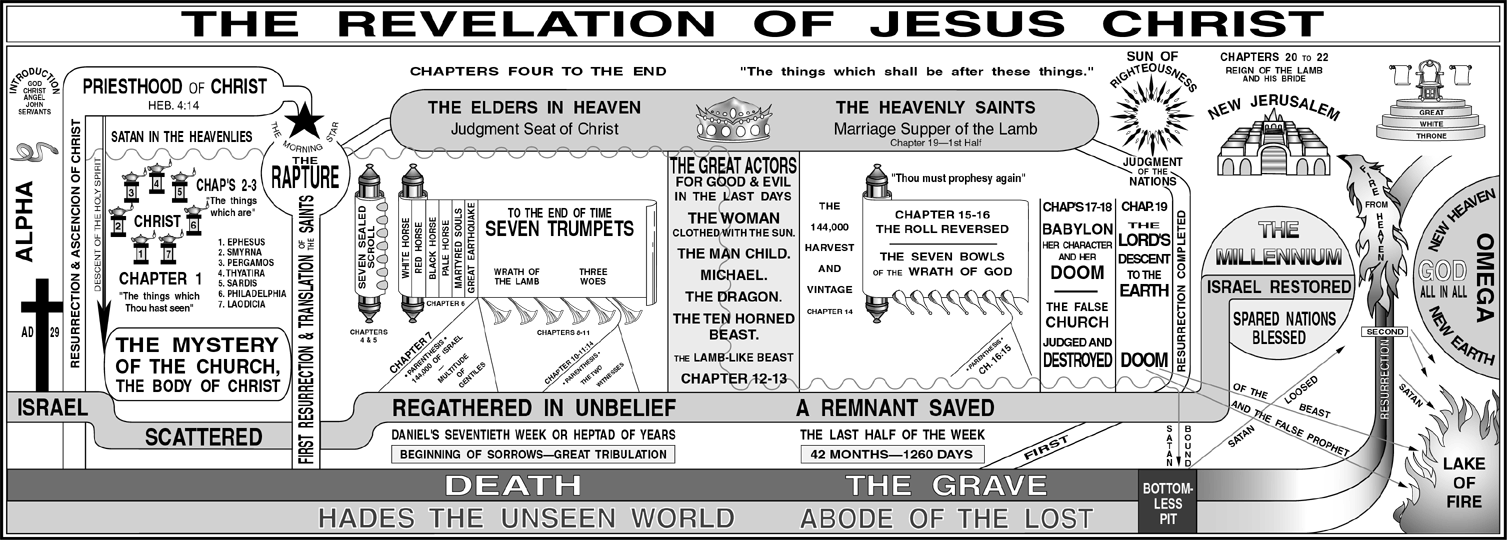
    • The Book of Revelation (Christian Bible)
    • Canto 12: The Age of Deterioration from the Srimad Bhagavatam
    • Tolkien’s Lord of the Rings
    • The concept of Jihad in Islam

    Each offers a lens into the spirit of the age—the Espíritu de la época—and together, they form a mythic tapestry of warning, hope, and transformation.

    📚 1984: The Dystopia of Surveillance and Submission

    George Orwell’s 1984 depicts a future ruled by the omnipresent Big Brother, where:

    • Thoughtcrime is the worst offense.
    • History is rewritten daily.
    • Individuality is crushed by the Party’s control.

    Winston Smith, the protagonist, rebels through love and thought—but is ultimately broken.
    He learns to love Big Brother.

    This is not a world of “happily ever after.”
    It’s a cautionary tale of totalitarianism, propaganda, and the erasure of truth.

    🕊️ Revelation: The Apocalypse and the Triumph of Good

    The Book of Revelation is the final chapter of the Christian Bible.
    It presents:

    • Letters to seven churches
    • The Four Horsemen: Conquest, War, Famine, and Death
    • The rise of the Beast and the False Prophet
    • The final battle between good and evil
    • The creation of a new heaven and new earth

    It’s a vision of judgment, redemption, and eternal hope.

    🕉️ Kali Yuga: The Age of Quarrel and Hypocrisy

    Canto 12 of the Srimad Bhagavatam describes Kali Yuga, the current age:

    • Morality and dharma decline.
    • Wealth defines worth; power defines righteousness.
    • Leaders become corrupt; society fractures.
    • Disease, anxiety, and ignorance rise

    But it also prophesies the arrival of Kalki, the tenth avatar of Vishnu, who will:

    • Ride a white horse
    • Wield a blazing sword
    • Destroy wicked rulers
    • Restore righteousness and begin a new golden age

    💍 The One Ring: Power, Corruption, and Sacrifice

    In Tolkien’s Lord of the Rings, the One Ring is forged by Sauron to dominate all others.

    • It corrupts its bearer.
    • It amplifies power—but only for domination.
    • It must be destroyed in Mount Doom, the fire from which it came

    Frodo, a humble hobbit, carries the Ring to its end—but only through sacrifice, struggle, and the help of others.

    ☪️ Jihad: The Struggle for Truth and Justice

    In Islam, Jihad means “struggle” or “effort.”

    • The greater jihad is internal: resisting selfish desires.
    • The lesser jihad is external: defending justice and truth

    It’s not simply “holy war”—it’s a multi-dimensional effort to live righteously, promote peace, and resist oppression.

    🔥 Armajihadden: The Final Conflagration

    This imagined term—Armajihadden—blends Armageddon with Jihad.
    It evokes:

    • A final reckoning
    • A spiritual war
    • A collapse of corrupted systems
    • A rebirth through struggle and sacrifice

    🧠 In the Realm of Make-Believe, Anything Is Possible

    Prophecies and fiction alike remind us:

    • The future is not fixed.
    • The will and means to change it exist.
    • Truth may be obscured, but it cannot be destroyed.

    Whether through Orwell’s dystopia, Revelation’s apocalypse, Kali Yuga’s decline, Tolkien’s ring, or Islam’s jihad—the message is clear:

    The struggle is real. The stakes are high. But the path to redemption is always open.


    Monday, September 22, 2014

    📜 My Heart Laid Bare: A Partial Testimony

    Birth seems the most fitting place to begin.
    I was born on August 19, 1982, at Portsmouth Naval Hospital in Portsmouth, Virginia. My birth certificate lists my Father and Mother as eyewitnesses. I was their firstborn—and only child from that marriage. My father had a daughter from a previous marriage, making her my older half-sister.

    🧸 Early Memories and the Mystery of the Crab

    My earliest memories trace back to a second-story apartment on Bainbridge Boulevard in Norfolk, VA, where I lived with my father around age 2 or 3.

    • I remember spilling cereal while trying to serve myself.
    • I remember jumping on my parents' bed and splitting my lip on the foot rail.
    • I remember waking early, flipping through channels, and discovering Pinwheel on Nickelodeon.
    • I remember opening my toy box and seeing what I thought was a live crab. I ran to get my dad’s future third wife—but when she looked, the crab was gone.

    Was it real? Or just imagination? That moment still puzzles me.

    👪 Family, Faith, and the First Fractures

    My biological parents divorced before I could form lasting memories.

    • I believed my dad’s third wife was my mother until age 7, when I noticed I had three sets of grandparents.
    • A phone call with my biological mom revealed I had two more siblings—a brother and a sister.
    • That discovery sparked a curiosity in me: a desire to learn what I didn’t know.

    Around this time, I began attending Great Bridge Church of Christ in Great Bridge, VA.

    • I was baptized in the name of the Father, the Son, and the Holy Ghost.
    • It was the first time I heard the names Jesus and God.
    • Innocence was lost soon thereafter.

    🔄 Born Again, Bit by Bit

    The concept of being “born again” eluded me then.
    But over time, it revealed itself—strangely, and often in ways society finds contemptible.
    This testimony is not a full autobiography, but a partial unveiling of the thoughts and experiences that shape my literary ambitions.

    🗡️ Suicide, Vanity, and the Samurai Code

    I’ve contemplated suicide—not from despair alone, but as a form of honor, akin to Seppuku, the ritual suicide of the samurai.

    • Seppuku was a way to die with dignity, to escape shame or torture.
    • It was a final act of agency.

    Benjamin Franklin once wrote in his autobiography:

    “Perhaps I shall a good deal gratify my own vanity... being persuaded that it is often productive of good to the possessor, and to others that are within his sphere of action.”

    Some of my maternal ancestors—Samuel Willard Saxton, Grace Birgfield, and Robert Murphy—inspire me to write autobiographically.
    At 32, a full autobiography felt premature. But a partial testimony felt right.

    🖋️ Poe’s Challenge: My Heart Laid Bare

    Edgar Allan Poe once wrote:

    “If any ambitious man have a fancy to revolutionize at one effort the universal world of human thought... all he has to do is to write and publish a very little book. Its title should be simple—‘My Heart Laid Bare.’”

    But to write it truthfully? “The page would shrivel and blaze at every touch of the fiery pen.”

    🌍 A Revolution of Innocence

    I’ve fancied suicide.
    I’ve fancied vanity.
    I’ve fancied revolution.

    But now, I fancy a revolution not of myself, but of higher power for the innocent—especially children.

    • No payment required but my own affirmative action.
    • No ambition but to push corruption as far into the past as possible.

    If this is conceivable, then the rest will follow.

    Monday, September 15, 2014

    🔍 Truth, Misinformation, and the Game We’re All Playing

    Buddha once said, “Three things cannot be long hidden: the Sun, the Moon, and the Truth.”

    Yet in today’s world, Truth often feels like Waldo—hidden in plain sight, obscured by a sea of distractions.


    🧩 The Waldo Effect: Truth in a Misinformation Landscape

    Imagine Truth as Waldo in a crowded scene.

    • The rest of the image? Misinformation, misdirection, and noise.
    • Journalists, media outlets, and official reports often serve as the background—colorful, detailed, but ultimately misleading.

    Martin Armstrong once argued that exaggeration is the golden rule of disinformation:

    “The Feds knew what they were up to and allowed it to happen... They exaggerated everything to destroy any credible investigation. This makes anyone who questions 9/11 a conspiracy nut job. Perfect cover to hide the truth right in front of your eyes.”

    This strategy doesn’t just obscure the truth—it weaponizes ridicule to silence dissent.

    🧠 Conspiracy vs. Principle

    Conspiracy theories often derail themselves by abandoning principle and resorting to Ad Hominem attacks.

    • Blaming shadowy groups like “the Illuminati” or “the Rothschilds” dilutes legitimate inquiry.
    • Ephesians 6:12 reminds us: “We wrestle not against flesh and blood, but against principalities.”
      The real battle is against systems and ideologies that prioritize ego and control over truth and cooperation.

    📰 The Press and the Engineering of Consent

    John Swinton, former chief of staff at the New York Times, said in 1880:

    “There is no such thing... as an independent press... We are intellectual prostitutes.”

    Edward Bernays, Freud’s nephew, pioneered public relations and authored books like Propaganda and The Engineering of Consent.

    • His work laid the foundation for manipulating public opinion through psychological and sociological techniques.
    • Truth became a nuisance—something to be managed, not revealed.

    🎮 Game Theory: The Rules Beneath the Surface

    Game theory reveals how individuals and groups strategize in competitive environments.

    • Cooperative games foster long-term sustainability.
    • Non-cooperative games drive short-term gains, often at great cost.

    Richard Dawkins’ documentary Nice Guys Finish First explores the Prisoner’s Dilemma and the success of the Tit for Tat strategy—cooperate unless provoked, retaliate if necessary, but always be quick to forgive.

    🌳 Good Trees, Good Fruit

    Matthew 7:16–20 offers a simple test:

    “By their fruits you shall know them.”

    If the system produces corruption, it’s a corrupt system.

    • Today’s game rewards materialism, misinformation, and exploitation.
    • The top players consume the Truth, profit from it, and discard the consequences.

    💸 Money, Time, and the Value of Truth

    Money has become the driver of society, but no one’s steering:

    “When money does all the driving... This is empire baby. And this train ain't stopping until it derails.” —Wu-Li

    Like money, time loses value when spent chasing illusions.

    • “Time is money” becomes a warning: inflation of lies devalues our lives.

    🌅 A New Enlightenment?

    Alexander Pope once said:

    “Men must be taught as if you taught them not, and things unknown proposed as things forgot.”

    Truth doesn’t need to be hidden—it needs to be reframed.

    • Make virtue profitable.
    • Teach children new rules.
    • Build a cooperative game where the best of humanity thrives.

    🧭 Final Thought: Finding Waldo

    Truth is there. It’s always been there.
    But like Waldo, it takes effort to find.
    And maybe that’s the point—if Truth were too easy to find, it wouldn’t be valued.


    Sunday, August 31, 2014

    👁️ Subjective Refraction of the Mind: A Curriculum for Clarity

    This post continues the ideas introduced in (Fall 2013), where I explored how learning can be tailored to clear the mental fog that clouds perception, while preserving the dignity and rights outlined in the Universal Declaration of Human Rights.


    🧠 What Is Subjective Refraction?

    In optometry, subjective refraction is the process of refining a person’s vision based on their feedback. It’s personal, adaptive, and precise.

    • Subjective (Merriam-Webster): Modified or affected by personal views, experience, or background.
    • Refraction: The action of distorting an image by viewing through a medium.

    In the realm of thought, our medium is our lived experience—our beliefs, traumas, culture, and education. These shape how we see the world, often distorting our perceptions of ourselves, others, and nature.

    🌈 The Spectrum of Human Thought

    Just as visible light is only a sliver of the electromagnetic spectrum, our optimal conceptions—our clearest, most insightful ideas—exist in a narrow band of mental clarity.

    • A curriculum designed to refract thought toward clarity would help individuals form and understand ideas in their best possible light.
    • Like an optometrist aiming for 20/20 vision, this curriculum would aim for conceptual clarity, tailored to each person’s background and emotional state.

    🧬 Empathy: The Lens for Clarity

    Jeremy Rifkin’s The Empathic Civilization animation explains how empathy is “soft-wired” into our brains.

    • Empathy is essential for overriding destructive impulses and building cooperative societies.
    • A curriculum that nurtures empathy can help individuals connect across differences and reduce fear of the unknown.

    🔍 Donder’s Method and Mental Focus

    In Donder’s method of eye testing, each eye is assessed individually for precision.

    • Similarly, mental clarity should be approached one focus area at a time—morals, education, trauma, beliefs—each refracted separately to avoid distortion.

    ⏳ Time Perspective and Emotional Fortitude

    Philip Zimbardo’s The Secret Powers of Time identifies six “time zones” people live in:

    • Past Positive / Past Negative
    • Present Hedonistic / Present Fatalistic
    • Future-Oriented (This Life) / Future-Oriented (Afterlife)

    Understanding which zone someone inhabits helps determine their emotional resilience and learning style.

    • Older adults may struggle more with new learning, but tailored approaches can still unlock growth.

    🌱 A Curriculum That Evolves

    Education should never stagnate. It must:

    • Adapt to individual needs and ambitions
    • Encourage lifelong learning
    • Foster cooperation over competition

    Children, especially, thrive in environments where learning is joyful and reciprocal.

    • A cooperative learning model can sustain the Will to contribute far longer than competitive systems that reward harmful behaviors.

    🕊️ Prescription for Mental Clarity

    Just as a phoropter liberates those with blurry vision, a curriculum based on Subjective Refraction of the Mind can guide individuals toward clarity, purpose, and empathy.
    It’s not about standardizing thought—it’s about standardizing clarity, while honoring the uniqueness of each mind.